A Garden Hose for a Small Yard: Buy for the Route, Not the Longest Reach
Choose a manageable hose for a small yard by checking the watering route, fittings, storage, plant access, and pressure-care instructions.
Our guidance is based on published information and household scenarios, rather than hands-on product testing. Some links may earn a commission when an affiliate relationship applies. Read our disclosure.
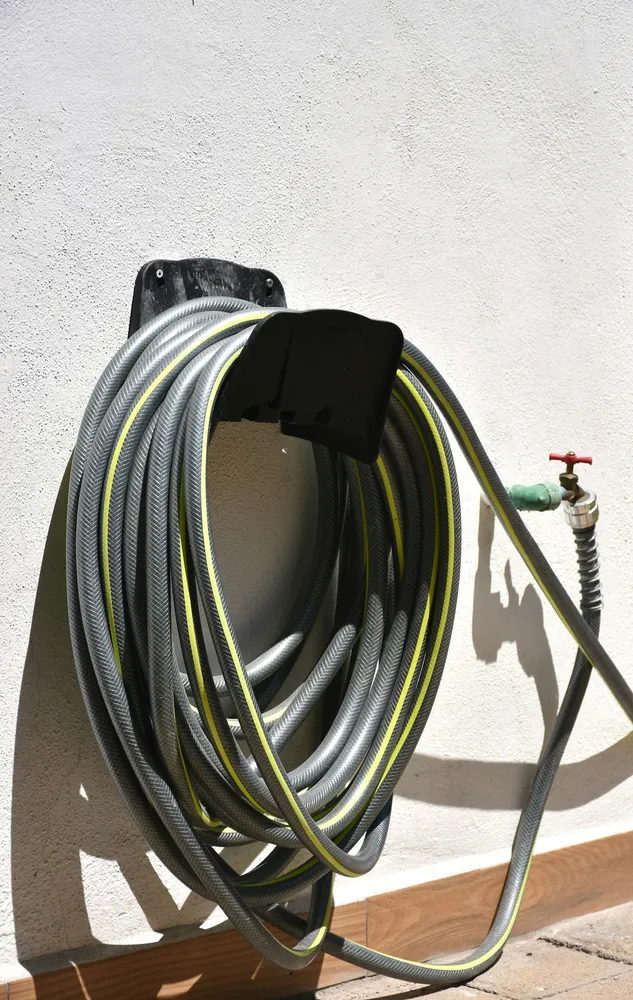
Lifestyle photography by Luigy Ghost / Unsplash. The photograph illustrates a home setting; it does not identify a reviewed product.
Watering six patio pots should be a short evening task. Instead, an oversized hose catches the chair legs, drags across a border, and leaves a coil in front of the back door. A small yard rarely benefits from choosing the longest hose automatically. The better purchase follows a realistic route from the faucet to the final plant and returns to a storage spot without blocking everyday use of the garden.
This guide uses official hose ranges and manufacturer care guidance to frame a practical choice. It does not report hands-on testing, comparative pressure measurements, or a universal claim that one material never kinks. Start with reach and handling, then compare the exact products that meet those needs.
In this guide
Measure the walking route to the farthest pot
Trace the path the hose must actually follow, allowing for beds, steps, corners, and furniture. A straight-line measurement across a planted border can understate the useful length needed to avoid dragging over plants. Conversely, choosing a large extra allowance can leave an unnecessary coil to handle after every watering. Use a tape or an existing cord to understand the route, then compare available hose lengths with a modest practical margin for moving the nozzle.
Think about access to the faucet as well. A connection tucked behind a pot may be hard to reach with wet hands, and a narrow gate can pinch the route when it closes. Reposition ordinary movable obstacles before solving the problem with more equipment. If the only plants are a short distance from the tap, a compact conventional hose may be enough. A more elaborate reel system should address a real storage or retrieval problem rather than become the starting assumption.
Choose a hose format around your watering job
Gilmour’s official lawn-and-garden range separates ordinary watering hoses from soaker and sprinkler formats. Those categories perform different jobs. A hose that brings water to a handheld nozzle is a sensible comparison for scattered patio containers. A soaker format belongs in a different decision about delivering water along a bed; it is not a direct replacement for carrying a nozzle from one pot to another. Match the method to the planting layout before comparing construction or appearance.
A lighter hose can be attractive when moving and coiling are the main nuisances, but category labels do not establish how every model handles. Gilmour publishes a dedicated lightweight range, while GARDENA’s US store lists conventional hose choices. Compare actual product length, weight where supplied, diameter, and operating guidance. Avoid buying on a broad kink-resistant promise alone. Routing, storage, and the way the hose is pulled remain part of the everyday experience.
Check the connections before adding accessories
Record the faucet connection and the attachments you already use. Confirm the intended thread and connector compatibility on the exact product listing, particularly when mixing brands or buying equipment from another market. A package called a system set may include useful fittings, or it may duplicate accessories already in the shed. Compare the complete setup cost rather than the hose alone. Include a suitable nozzle only if the existing one does not serve the plants or fit the proposed arrangement.
Leaking connections deserve attention before replacing the full length. Inspect components according to the manufacturer’s guidance and use suitable replacement parts when appropriate. Do not compensate for a poor connection by forcing mismatched fittings together. Likewise, do not assume every ordinary garden hose is suitable for drinking water, indoor use, hot water, or continuous pressure. Those uses need explicit product approval; a familiar-looking connection does not establish that approval.
Protect the plants while delivering water
When the path bends around a bed, the hose may pull toward the inside corner and sweep across stems. Move along the route deliberately and reposition the hose rather than tugging from the farthest point. A suitable guide can be considered where that corner causes repeated trouble, provided installation suits the site. But a guide is an accessory to a workable route, not a reason to run the hose through a crowded planting area unnecessarily.
Match the water outlet to the task. Container plants benefit from controlled delivery to the potting mix rather than an indiscriminate blast over the entire patio. For plant-specific watering needs, consult relevant extension guidance and observe the growing medium rather than watering merely because the hose is already out. Maryland Extension’s water-conservation advice includes repairing leaking hose connections, a useful reminder that preventing waste can begin with a small maintenance job instead of a larger purchase.
Include shutdown and storage in the buying decision
Choose the storage location while the hose is on your shortlist. A free-standing coil needs enough room to remain out of the doorway; a reel needs suitable placement and, if mounted, an appropriate installation surface and permission. Read the particular hose and accessory instructions for shutdown, pressure release, drainage, and winter storage. GARDENA’s official support guidance says to avoid constant pressure and pulling strain for the garden hoses covered by its advice. Do not treat that as a promise that every other brand accepts those conditions.
Spend on a manageable length and compatible fittings before paying for a larger reel or more spray patterns. Walk through the routine in order: turn on, reach the plants, control delivery, turn off, follow the prescribed pressure and drainage steps, and put everything away. If that sequence crosses a dining area or forces a heavy coil through a narrow gap, revise the layout. The best hose for a small yard is one you can use and restore without making the garden harder to enjoy.
Compare your options
| Option | Best fit | Tradeoff |
|---|---|---|
| Conventional garden hose sized to the route | Mixed watering jobs within a small yard | Needs an accessible coiling or reel location after use |
| Model-specific lightweight hose | A household prioritizing carrying and putting away the hose | Material and care claims must be checked for the exact model |
| Soaker hose | A suitable fixed bed-watering layout | Does not serve the same moving-nozzle task as watering scattered pots |
Where to browse
Use these retailer collections to compare dimensions, materials, care instructions and current prices. These are ordinary retailer links unless an active affiliate arrangement is disclosed. We do not control availability, shipping or returns.
Questions before you buy
Should I buy extra length just in case?
Allow enough practical slack for the real route, but avoid automatically buying the longest option. Unneeded length still has to be moved and stored whenever you water.
Can I leave the faucet on with the nozzle closed?
Follow the exact hose and accessory instructions. GARDENA’s cited support guidance advises avoiding constant pressure for the garden hoses it describes; a closed nozzle is not permission to ignore the product’s shutdown guidance.
Sources & further reading
- Gilmour official lawn-and-garden hose formats
- GARDENA US support: intended garden-hose use and pressure care
- University of Maryland Extension: conserve water in your landscape
Sources checked October 20, 2026. Practical suggestions reflect editorial judgment; always follow the instructions supplied with your own product.